
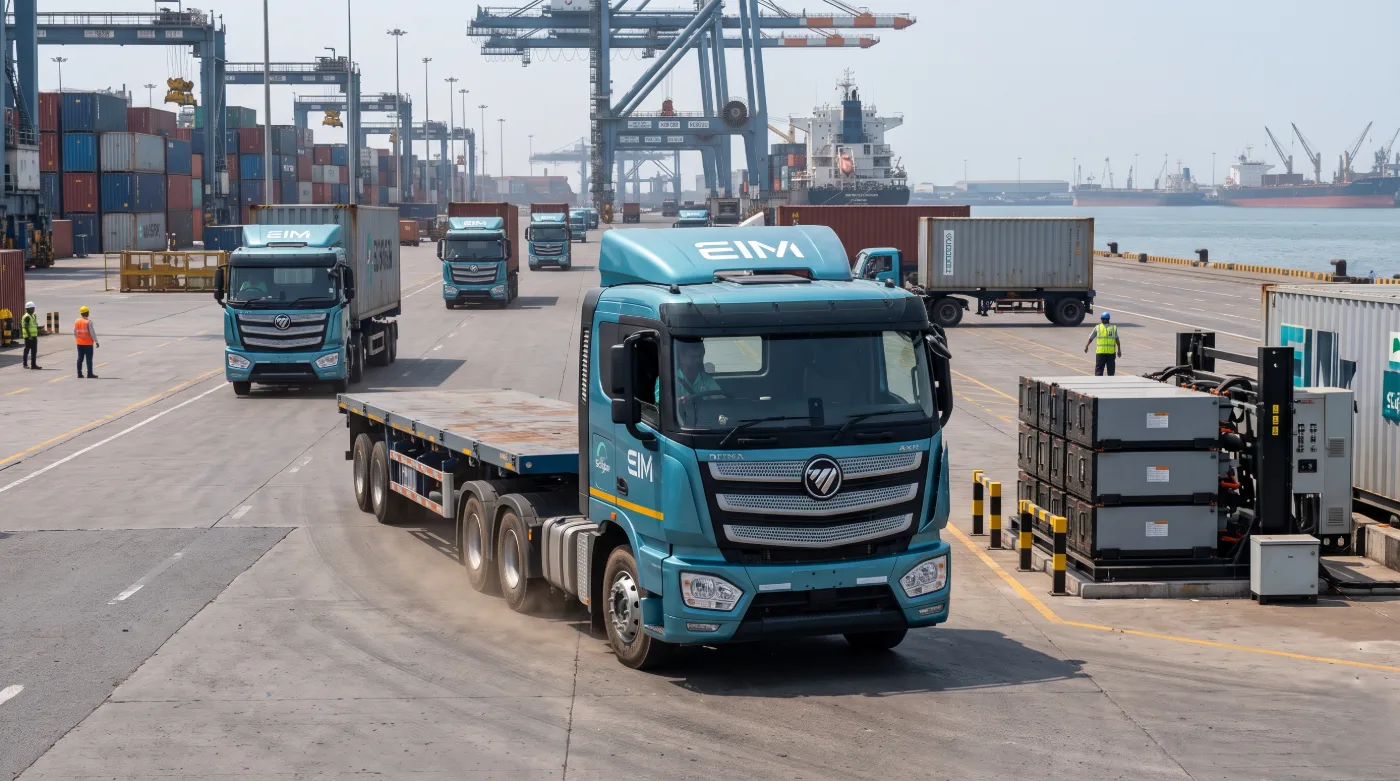
The agreement, announced in early November, marks a significant scale-up in India's heavy electric freight segment, moving from pilot projects to commercial deployment. EIM will supply its Ashwa 55-tonne electric tractors along with charging infrastructure, battery-swapping networks, and energy-management solutions designed to address vehicle utilization, turnaround time, and operating costs for fleet operators.
Sorigin Green Mobility will finance, deploy, operate, and maintain the fleet under a managed service model. Customers pay for cargo moved rather than purchasing vehicles or batteries outright, removing the capital barrier that has slowed electric heavy truck adoption in India. Sorigin already operates EIM tractors at Jawaharlal Nehru Port and Tuticorin Container Terminal, allowing the programme to begin with actual deployment rather than further pilots.
The initial 18-vehicle rollout will be concentrated within the JNPA ecosystem, India's largest container-handling port complex. EIM has already established battery-swapping infrastructure near the port, including a second heavy-duty swapping station at Nhava Sheva Distribution Terminal opened in September 2026. The company has stated that nearly 150 of its electric trucks were already operating within the JNPA ecosystem prior to this new agreement.
EIM's business model separates battery ownership from vehicle ownership through a subscription service, reducing the initial investment required from truck owners. Compatible trucks can exchange depleted battery packs for charged ones rather than waiting for on-vehicle charging, a critical factor for port drayage operations where vehicle uptime directly affects freight economics.
The vehicles are supported by EIM's manufacturing facility at Talegaon in Pune, inaugurated in October 2026, which combines vehicle assembly, lithium-ion battery-pack assembly, and battery testing with an initial capacity of 5,000 units annually on a single shift. EIM's technology partnerships include BAIC Foton Motor for heavy electric vehicles and Contemporary Amperex Technology for battery technology.
Narendra Murkumbi, Managing Director of EIM, framed the partnership as addressing the operational requirements that determine whether electric heavy freight is commercially viable: "By combining our Ashwa 55-tonne electric tractor with charging infrastructure, battery-swapping solutions and energy management capabilities, we aim to address critical operational requirements such as vehicle utilisation, turnaround time and energy costs".
Sorigin's directors emphasized that the service model is designed to make the transition frictionless for cargo owners. "We finance, deploy, operate and maintain the fleet with guaranteed uptime, so customers pay only for the freight they move, with no upfront capex," said Gautam Rekhi and Aarav Tanti in a joint statement. The partnership targets port and industrial supply chains where diesel heavy trucks currently dominate.
The initiative aligns with India's broader decarbonization goals for heavy transport, a segment that has proven resistant to electrification due to high vehicle costs, long charging times, and demanding duty cycles. By concentrating on cargo-intensive port corridors where routes are predictable and return-to-base operations are feasible, the EIM-Sorigin model tests whether battery swapping and managed fleet services can overcome the economics that have limited electric truck adoption in Indian logistics.