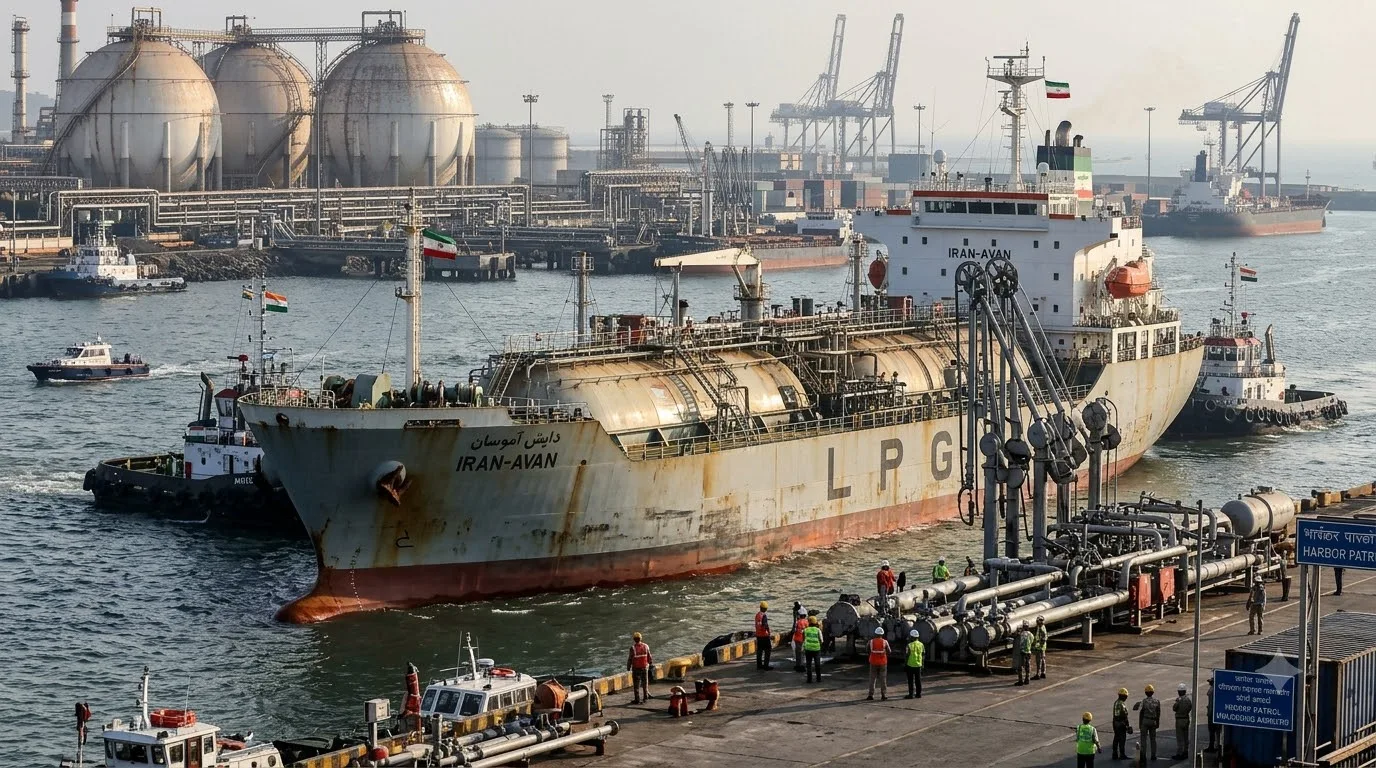
<p class="ds-markdown-paragraph" style="margin: 16px 0px; color: rgb(15, 17, 21); font-family: quote-cjk-patch, Inter, system-ui, -apple-system, BlinkMacSystemFont, "Segoe UI", Roboto, Oxygen, Ubuntu, Cantarell, "Open Sans", "Helvetica Neue", sans-serif; font-size: 16px;"><span class="">India has bought its first cargo of Iranian liquefied petroleum gas in years, taking advantage of a temporary US waiver on sanctions against Tehran's oil and refined fuels to secure supplies amid the worst LPG crisis the country has faced in decades . The cargo, carried by the sanctioned tanker Aurora, was initially bound for China but was redirected to India and is expected to arrive shortly at the west coast port of Mangalore, according to LSEG trade flows and three industry sources cited by Reuters and The Hindu .</span></p><p class="ds-markdown-paragraph" style="margin: 16px 0px; color: rgb(15, 17, 21); font-family: quote-cjk-patch, Inter, system-ui, -apple-system, BlinkMacSystemFont, "Segoe UI", Roboto, Oxygen, Ubuntu, Cantarell, "Open Sans", "Helvetica Neue", sans-serif; font-size: 16px;"><span class="">The payment mechanism is a significant element of the arrangement. The cargo was purchased from a trader, and payment will be made in Indian rupees, according to the sources . This marks a revival of the rupee-payment mechanism with Iran, which had been dormant since India shunned Iranian energy purchases in 2019 under pressure from Western sanctions. The use of rupees reduces dependence on dollar-denominated transactions and eases pressure on foreign exchange reserves, while also insulating the trade from some of the financial infrastructure that US sanctions target.</span></p><p class="ds-markdown-paragraph" style="margin: 16px 0px; color: rgb(15, 17, 21); font-family: quote-cjk-patch, Inter, system-ui, -apple-system, BlinkMacSystemFont, "Segoe UI", Roboto, Oxygen, Ubuntu, Cantarell, "Open Sans", "Helvetica Neue", sans-serif; font-size: 16px;"><span class="">The cargo will be shared among India's three state-owned fuel retailers: Indian Oil Corporation, Bharat Petroleum Corporation, and Hindustan Petroleum Corporation . These are the same companies that have been managing India's LPG supply disruption, and their participation in the Iranian cargo indicates a coordinated government response to the shortage. India consumed 33.15 million tonnes of LPG last year, with imports accounting for about 60% of demand, and about 90% of those imports came from the Middle East before the Hormuz crisis .</span></p><p class="ds-markdown-paragraph" style="margin: 16px 0px; color: rgb(15, 17, 21); font-family: quote-cjk-patch, Inter, system-ui, -apple-system, BlinkMacSystemFont, "Segoe UI", Roboto, Oxygen, Ubuntu, Cantarell, "Open Sans", "Helvetica Neue", sans-serif; font-size: 16px;"><span class="">The context for the purchase is a severe supply crunch. The disruption of energy shipments via the Strait of Hormuz, caused by the US-Israeli war against Iran, has hit India hard. The government has cut LPG supplies for industries to shield households from a shortage of cooking gas, and the world's second-largest LPG importer has been battling its worst gas crisis in decades . The Iranian cargo is a lifeline that diversifies supply away from the Gulf routes that have been disrupted, and it comes at a time when India has also been moving stranded LPG cargoes out of Hormuz and loading its empty vessels in the Persian Gulf.</span></p><p class="ds-markdown-paragraph" style="margin: 16px 0px; color: rgb(15, 17, 21); font-family: quote-cjk-patch, Inter, system-ui, -apple-system, BlinkMacSystemFont, "Segoe UI", Roboto, Oxygen, Ubuntu, Cantarell, "Open Sans", "Helvetica Neue", sans-serif; font-size: 16px;"><span class="">There is a caveat to the reported purchase. Rajesh Kumar Sinha, special secretary in the federal shipping ministry, said at a press conference on Wednesday that he was not aware of Iranian cargoes being bought, stating: "There are no loaded cargoes from Iran, we have not heard of that" . The three companies and India's oil ministry did not immediately respond to requests for comment. This official denial introduces uncertainty about whether the cargo has been formally confirmed at the government level, even as trade sources and shipping data indicate that the transaction is proceeding.</span></p><p class="ds-markdown-paragraph" style="margin: 16px 0px; color: rgb(15, 17, 21); font-family: quote-cjk-patch, Inter, system-ui, -apple-system, BlinkMacSystemFont, "Segoe UI", Roboto, Oxygen, Ubuntu, Cantarell, "Open Sans", "Helvetica Neue", sans-serif; font-size: 16px;"><span class="">For India's energy security, the Iranian LPG purchase represents a pragmatic adaptation to a disrupted market. The Hormuz crisis has forced India to look beyond its traditional Gulf suppliers, and the temporary US sanctions relief has created a window of opportunity to access Iranian supplies that were previously off-limits. If the arrangement proves sustainable and the payment mechanism functions smoothly, it could open a new channel for LPG imports that reduces India's exposure to the chokepoint that has caused the current crisis.</span></p><p class="ds-markdown-paragraph" style="margin: 16px 0px; color: rgb(15, 17, 21); font-family: quote-cjk-patch, Inter, system-ui, -apple-system, BlinkMacSystemFont, "Segoe UI", Roboto, Oxygen, Ubuntu, Cantarell, "Open Sans", "Helvetica Neue", sans-serif; font-size: 16px;"><span class="">Looking ahead, the key questions are whether the cargo arrives without incident, whether the rupee-payment mechanism operates as intended, and whether further Iranian LPG purchases follow. The official denial from the shipping ministry suggests that the government is being cautious about publicly confirming a transaction that involves a sanctioned entity, even under a temporary waiver. For now, the trade data and industry sources indicate that India has taken a significant step toward diversifying its LPG supply, and the arrival of the Aurora at Mangalore will be the first tangible test of whether that step delivers the relief that India's cooking gas market needs.</span></p>
India Buys First Iranian LPG Cargo in Years After US Sanctions Waiver, Pays in Rupees
India has purchased its first cargo of Iranian liquefied petroleum gas in years after the United States temporarily eased sanctions on Tehran's oil and refined fuels. The cargo, initially bound for China, was redirected to India and is expected to arrive at Mangalore port on the west coast. Payment will be made in Indian rupees, and the cargo will be shared among Indian Oil Corporation, Bharat Petroleum Corporation, and Hindustan Petroleum Corporation. India, the world's second-largest LPG importer, has been grappling with its worst gas crisis in decades due to the Hormuz disruption.