
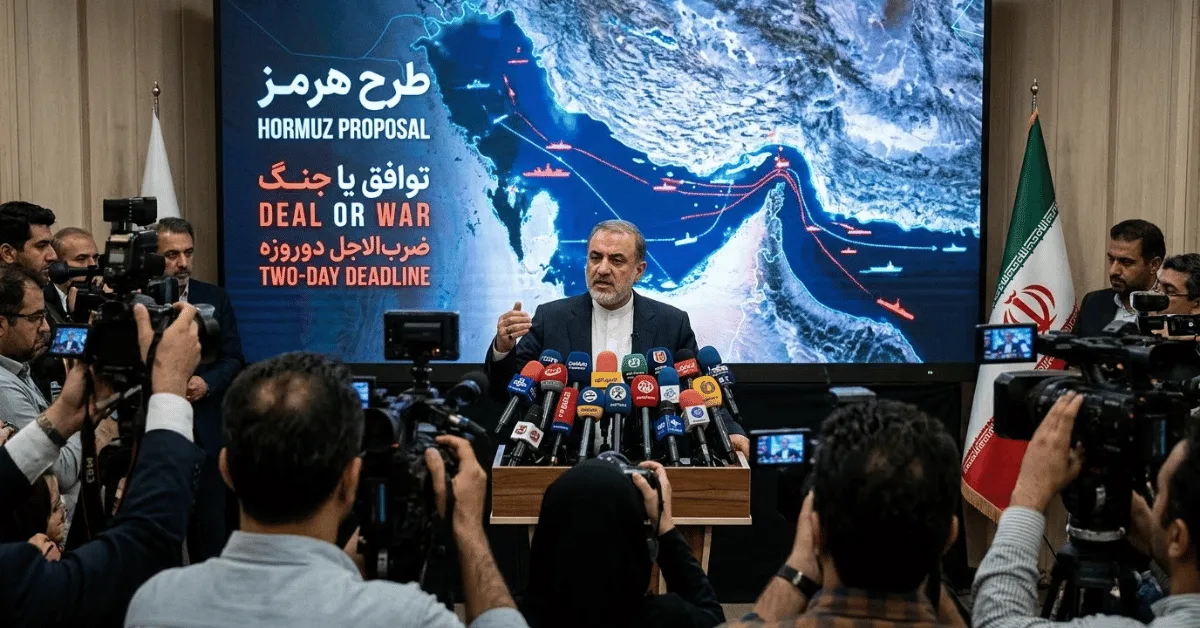
Iran has reaffirmed that its two-day proposal to reopen the Strait of Hormuz remains on the table, with Foreign Ministry spokesman Esmaeil Baqaei stating on 9 November 2026 that the plan offers a "clear, time-bound framework" for resolving tensions in the strategic waterway . Speaking at his weekly press conference, Baqaei clarified that Tehran had not submitted any new proposal to Washington, and that the existing two-day plan remained the operative offer .
The structure of the proposal is sequential and conditional. On the first day, the United States would be required to take a series of agreed measures: lifting its naval blockade on Iranian ports, ending hostilities on all fronts, releasing frozen Iranian assets, and removing sanctions imposed in recent months . On the second day, the Strait of Hormuz would reopen and traffic would return to its previous state . Baqaei claimed these demands had already been accepted by Washington under the 14-point Islamabad memorandum reached in June, but accused the US of subsequently violating its commitments .
The diplomatic context has become more complex since the US midterm elections on 3 November. Iranian Foreign Minister Abbas Araghchi said on 8 November that American voters had made their choice, and that it was time for the White House to make its own . "Our 2-day proposal stands: meet the requirements, including end to war on all fronts, and you will see results. Or choose war, and see our alert and battle-hardened warriors rain down hell," Araghchi wrote on X . The statement frames the choice in stark terms, presenting the proposal as a final diplomatic opportunity rather than an opening bid.
Baqaei also addressed the mechanics of Hormuz transit, stating that all vessels passing through the strait must coordinate with Iranian authorities to ensure safe navigation . He blamed recent insecurity in the waterway on US and Israeli military actions, while insisting that Iranian forces remain prepared to respond to threats . This assertion of Iranian regulatory authority over the strait is consistent with Tehran's broader position that it controls access to the waterway, a claim the US has rejected.
The mediators involved in the diplomatic track are Pakistan and Qatar. Baqaei expressed appreciation for their efforts, and noted that Iran maintains regular consultations with both . The 14-point Islamabad memorandum, reached through Pakistani mediation in June, provided the original framework for de-escalation, including arrangements concerning maritime security in Hormuz, sanctions relief, and the cessation of hostilities . However, disagreements over implementation and renewed military confrontations have prevented a lasting settlement.
For India, the two-day proposal represents the most concrete diplomatic pathway to a potential reopening of the Strait of Hormuz since the conflict began. India's crude and LNG imports depend heavily on the strait, and any reopening would reduce the freight, insurance, and risk premiums that have inflated India's energy import bill throughout 2026. However, the plan's conditionality—requiring the US to lift its blockade and make significant concessions—means that the probability of implementation remains uncertain, and Indian refiners should continue to plan on the assumption that the strait will remain constrained in the near term.
Looking ahead, the key variable is whether Washington will engage with the proposal or pursue military escalation. The US has not publicly responded to the two-day plan, and its naval blockade remains in effect. For shipping and energy markets, the diplomatic track provides a reason for cautious optimism, but the military preparations on both sides suggest that the risk premium is unlikely to dissipate quickly regardless of which path prevails. For now, the proposal stands as Iran's offer, and the decision on whether to accept it rests with Washington.