
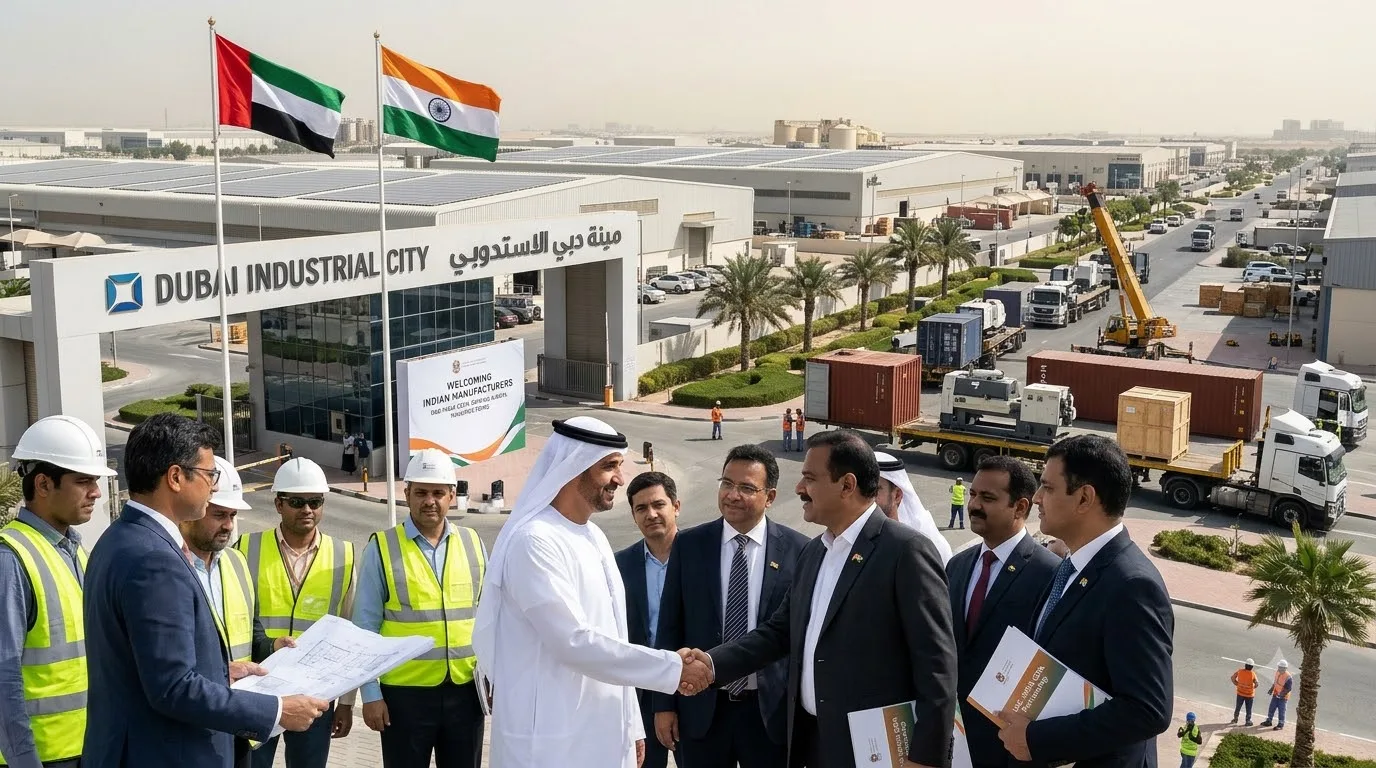
Dubai Industrial City is actively courting Indian manufacturers as the UAE-India Comprehensive Economic Partnership Agreement drives a wave of factory relocations and expansions by Indian companies seeking a manufacturing and export base in the Gulf . Saud Abu Alshawareb, Executive Vice President for Industrial Leasing at TECOM Group, said Indian companies are increasingly setting up facilities in the zone across steel, glass, food and beverage, and pharmaceuticals, and that Dubai Industrial City is looking to attract more Indian businesses by leveraging the benefits of CEPA .
The scale of the existing presence provides a foundation for further growth. Dubai Industrial City already hosts 1,100 business partners and more than 350 operational factories, with occupancy levels across the area close to 98% . The zone's location near Jebel Ali Port, Al Maktoum International Airport and major highways gives manufacturers access to logistics infrastructure that connects them to regional and international markets, a factor that is particularly relevant for Indian companies seeking to serve Middle East, African, and European customers from a base outside India.
The CEPA, which came into effect in May 2022, has been the catalyst for much of this interest. The agreement reduced tariffs on a wide range of goods and improved market access between the two countries, making it commercially attractive for Indian manufacturers to establish operations in the UAE rather than serving the market entirely through exports from India . Bilateral trade reached $101.25 billion in FY2025-26, and both countries have agreed to work toward increasing that figure to $200 billion by 2032 .
The trend extends beyond Dubai Industrial City. Jebel Ali Free Zone, operated by DP World, drew AED 1 billion in fresh investment and saw more than 270 Indian firms start up there in the first half of 2026, according to DP World's Chief Operating Officer Abdulla Al Hashimi . This concentration of Indian business activity in Dubai's industrial and free zones reflects a broader pattern: Indian companies are using the UAE not only as a market but as a manufacturing and logistics platform for regional and global trade.
The sustainability and technology dimensions of Dubai Industrial City's offering are also relevant to Indian manufacturers. The zone is working with the UAE Ministry of Industry and Advanced Technology to assess existing factories for digitalisation and automation under the Industrial Technology Transformation Index . For Indian companies investing in new facilities, the availability of these programmes and the broader UAE government procurement pipeline—projected at more than $43 billion over the next decade—adds to the incentive to establish local manufacturing operations.
For India's export and logistics sector, the trend has mixed implications. On one hand, Indian companies expanding into the UAE create new trade flows and demand for shipping and logistics services between the two countries. On the other, the relocation of manufacturing capacity to the UAE could reduce some export volumes from India, particularly in sectors where the CEPA makes UAE-based production more competitive for regional markets. The net effect will depend on the balance between new trade creation and production displacement.
Looking ahead, the key variable is whether the CEPA-driven investment trend continues at its current pace. The agreement's tariff benefits and the UAE's logistics infrastructure provide a durable foundation, but the security environment in the Gulf and the broader regional disruption could affect investment decisions. For now, Dubai Industrial City's near-full occupancy and the flow of Indian firms into Jebel Ali Free Zone suggest that the UAE remains an attractive destination for Indian manufacturers, and that the CEPA is delivering on its promise of deeper economic integration.