
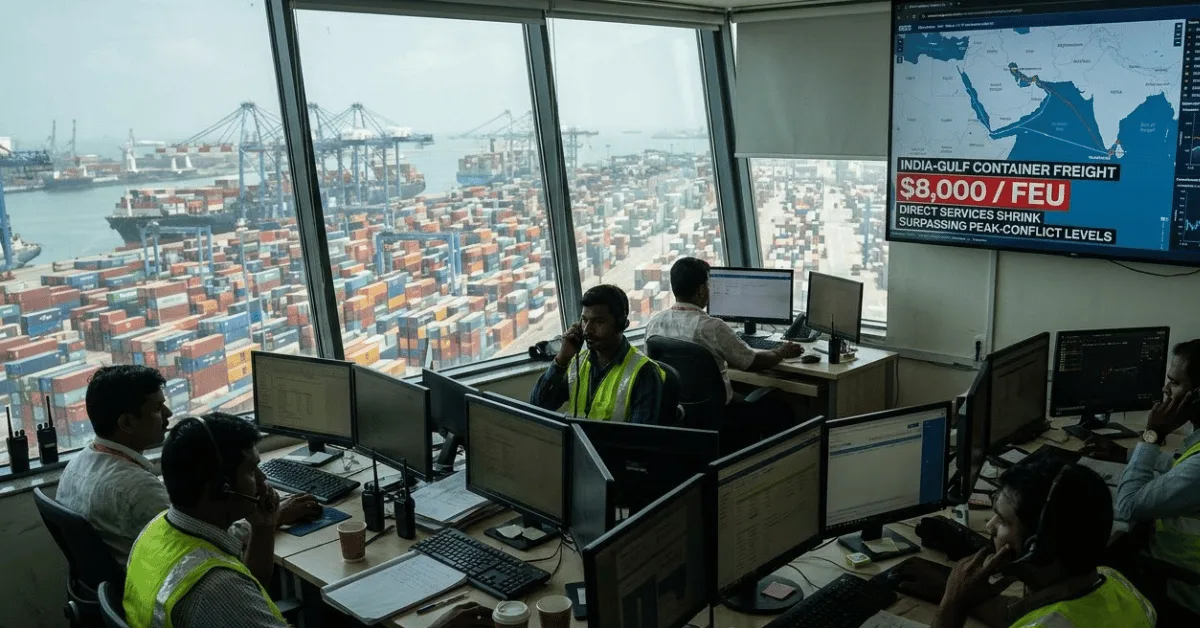
Ocean freight rates on India's major export routes remain at elevated levels despite a lull in West Asia hostilities, with shipments to the Gulf now more expensive than during the June-July period when fighting and attacks on shipping were at their most intense . According to industry data reported by Financial Express and 金十数据, the cost of shipping a 40-foot container from Indian ports to Jebel Ali in the UAE has climbed to around $8,000, up from about $5,500 during the conflict peak and just $800 before the war .
The scale of the increase is stark across all major trade lanes. US-bound rates are ruling at $12,000 per 40-foot container, compared with around $6,000 during the June-July period and $3,000-3,500 before the conflict began in February . Europe-bound rates stand at $8,500, up from $3,500-4,000 during the conflict and around $2,000 pre-war . These figures include all surcharges that shipping companies levy, meaning the effective cost to exporters is the full amount quoted, not a base rate subject to additional add-ons.
The paradox of rates rising while hostilities have eased is explained by the structure of the shipping market rather than the security situation alone. Shipping lines remain reluctant to deploy vessels into the Persian Gulf, direct services have been reduced, cargo is being diverted to alternative ports, and congestion at transshipment hubs persists . These factors have combined to tighten effective capacity on the India-Gulf corridor even as the volume of ships crossing Hormuz has increased, creating a situation where the physical availability of vessels willing to serve the route has not recovered in line with the easing of attacks.
The impact on exporters is concentrated in low-value, high-volume product categories. Ajay Sahai, Director General and CEO of the Federation of Indian Export Organisations, said "the worst affected were low value high volume products such as ceramics, wooden furniture, cement, coir products, non-basmati rice and other cereals" . These are products where freight represents a large share of the delivered cost, and where a rate increase of the magnitude seen since February can render exports commercially unviable rather than merely less profitable.
The broader export performance provides context for why the rate issue matters. India's merchandise exports grew 18.5% to $259.89 billion in the first half of FY27, with some of the growth driven by higher realisations from petroleum products as crude oil prices remain high . Volume growth is also visible in electronics and in market diversification into the ASEAN bloc, Northeast Asia, and Africa . But the FIEO chief noted that high shipping costs are eroding margins, particularly in the Gulf, Europe, and US markets, meaning that the headline export growth masks a squeeze on profitability in key segments.
The outlook is uneven across routes. Europe could see further relief if the return to Suez Canal routings becomes more widespread, while US-bound rates may moderate as seasonal demand subsides . The Gulf, however, is likely to remain the most vulnerable corridor until shipping lines restore regular services, port operations normalise, and war-related surcharges and insurance costs come down . Analysts also noted that the US midterm election outcome is unlikely to have an immediate bearing on freight rates, with any impact coming indirectly through subsequent changes in US trade and tariff policy.
Looking ahead, the key variable for Indian exporters is whether the shipping lines' reluctance to deploy capacity to the Gulf eases as the security situation stabilises. The return of direct services and the normalisation of port operations in the region would be necessary conditions for rates to decline meaningfully, and neither appears imminent. For now, exporters on the Gulf corridor face a cost structure that is more punitive than at the height of the conflict, and the relief package being consulted on by DGFT is a response to a market that has not self-corrected.